
How to Find Allen County Arrest Records
The fastest source for a recent arrest is the Sheriff's online jail roster at allencountysheriff.org. It lists people currently booked into the Allen County Jail, with a photo, name, and booking date for each. You search by first name, last name, or booking date, then open a person's detail page for charges and bond. The roster is free and needs no account.
For the criminal court case that follows an arrest, switch to Indiana MyCase. That is where charges, hearings, pleas, and sentences live once the Prosecutor files.
- Open the Sheriff inmate search for anyone in custody now.
- Enter a first name, last name, or booking date and run the search.
- Open the inmate detail page to read charges, cause numbers, and bond.
- For the court case, search MyCase by name and set the court to Allen County.
- For an older record, request a criminal records check from the Sheriff.
The Allen County inmate records page covers the roster tool in full detail.
Arrest Record vs Criminal Court Record
An arrest record and a criminal court record are two different files. The arrest record is the Sheriff's booking data. The court record is the case the Prosecutor builds and the court decides. One can exist without the other, since not every arrest leads to a charge and not every charge starts with a jail booking.
| Arrest Record | Criminal Court Record |
|---|---|
| Kept by the Sheriff | Kept by the Clerk and courts |
| Booking, mugshot, jail charges, bond | Charges filed, pleas, hearings, sentence |
| Found on the jail roster | Found on MyCase |
| Snapshot at intake | Full life of the case |
For the full case history, use Allen County court records rather than the roster alone.
What an Allen County Arrest Record Shows
The Sheriff's inmate detail page is specific. A sampled profile listed the person's mugshot, name, age, gender, race, height, weight, hair color, and eye color. It showed the booking date and an inmate number. A charges section followed, and each charge carried its own fields.
- Statute and statute description, such as a domestic battery or burglary code.
- Cause number, the court case tied to the charge.
- Bond type, such as cash, surety, or pretrial services.
- Bond amount set for release.
The inspected profile did not show an arresting agency, a housing pod, a court date, or a release date. For those, you check the court case or call the jail. Birth dates and some identifiers stay off public records.
One limit is worth knowing. The roster shows current custody only. It lists people in the jail right now, not a full arrest history. Once a person is released, they drop off the public roster, even though the underlying court case stays on file. To trace an arrest from a week or a year ago, you move to the court record or a Sheriff records check. The roster is a live snapshot, not an archive of every booking the county has ever made.
Charges vs Convictions
This is the distinction that matters most. A charge is an accusation. A conviction is a finding or plea of guilt. Many charges end in dismissal, acquittal, or a reduced plea, so reading a charge as guilt is a mistake. The court record, not the arrest record, tells you the outcome.
| Charge | Conviction |
|---|---|
| An accusation by the State | A guilty finding or plea |
| Appears at booking and filing | Appears at disposition |
| Can be dropped or reduced | Leads to a sentence |
To confirm how a case ended, read the disposition on the Allen County court docket.
The Allen County Prosecutor's Role
The Allen County Prosecuting Attorney represents the State in felony and misdemeanor cases that arise in the county. The office files charges, conducts criminal investigations, convenes and supervises grand juries, and handles traffic and other state-law infractions. It also runs juvenile prosecutions and a Child Support Division. Michael McAlexander has led the office since January 2023.
The screenshot below shows the official Prosecutor page.
This image comes from the Allen County Prosecuting Attorney page.
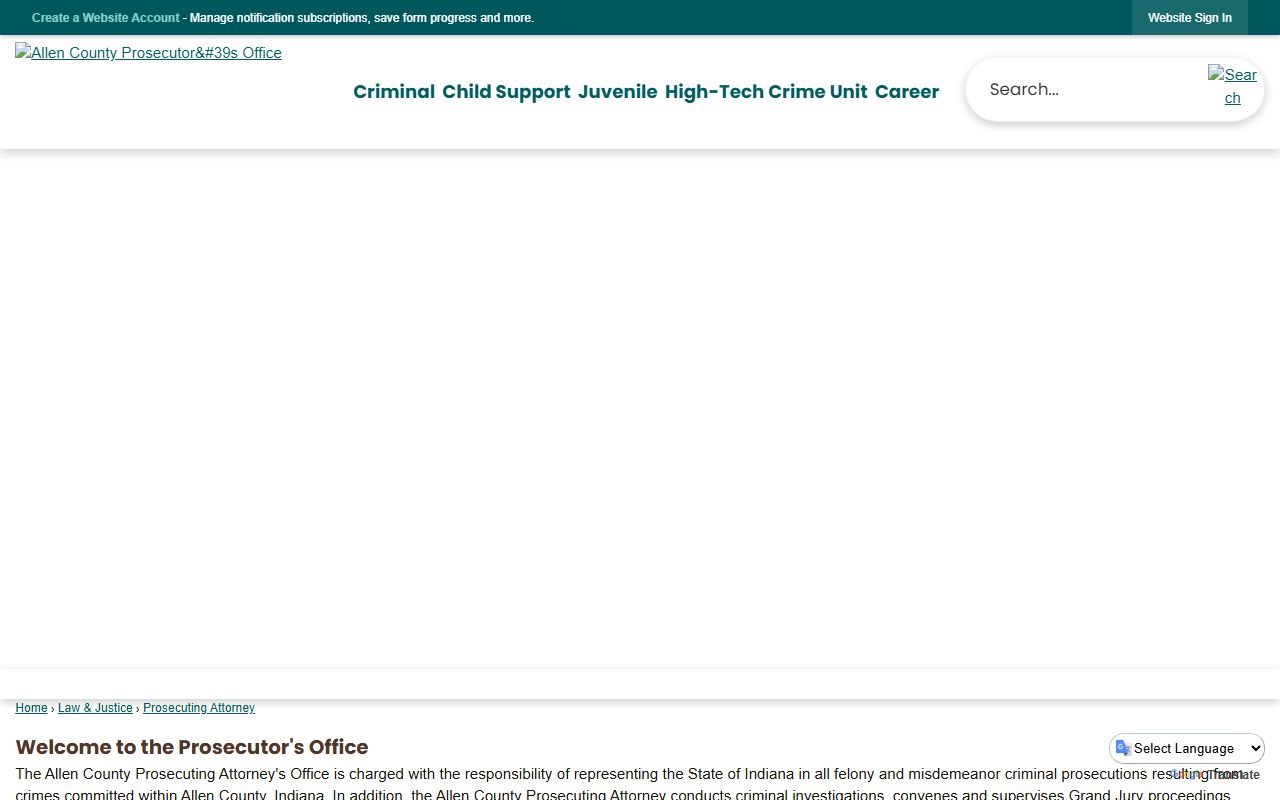
The office also runs a Misdemeanor Complaint Program for incidents that did not lead to an arrest and an Infraction Deferral Program for eligible traffic tickets.
Public Defender and Indigent Defense
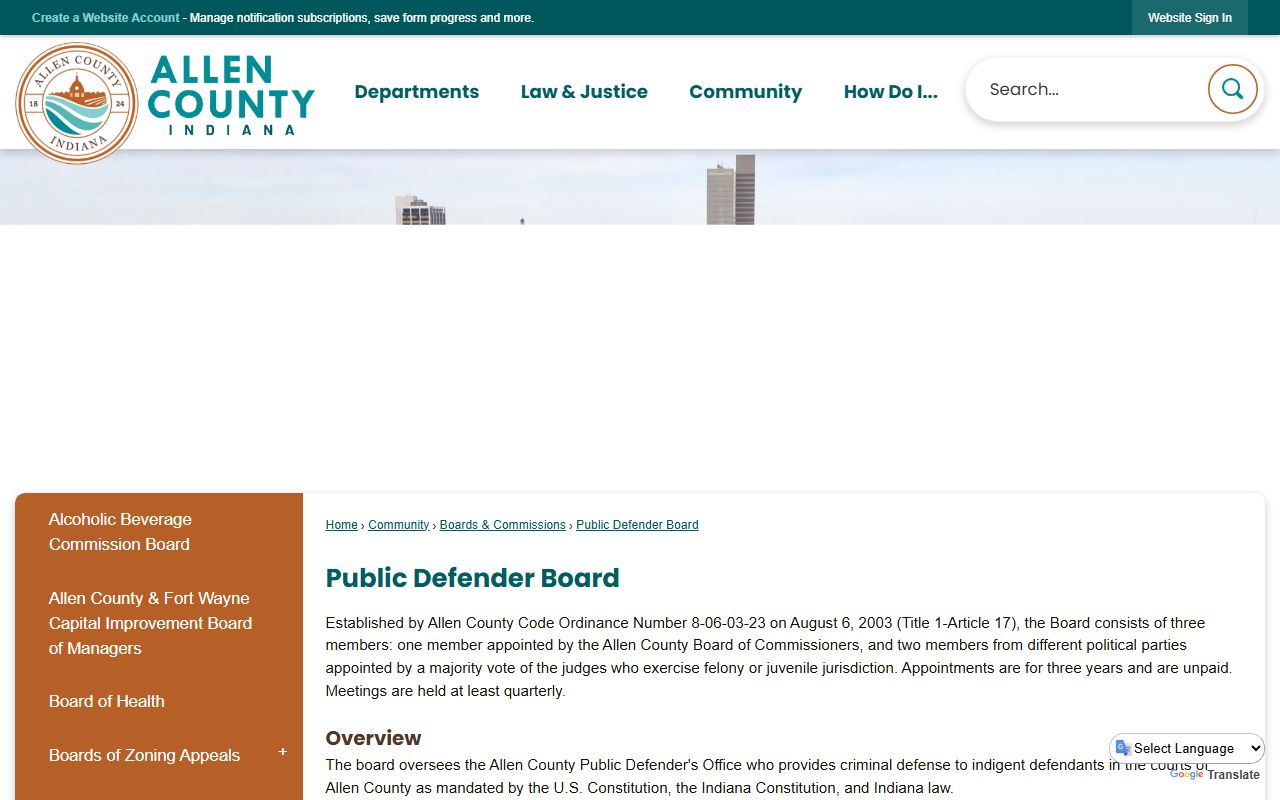
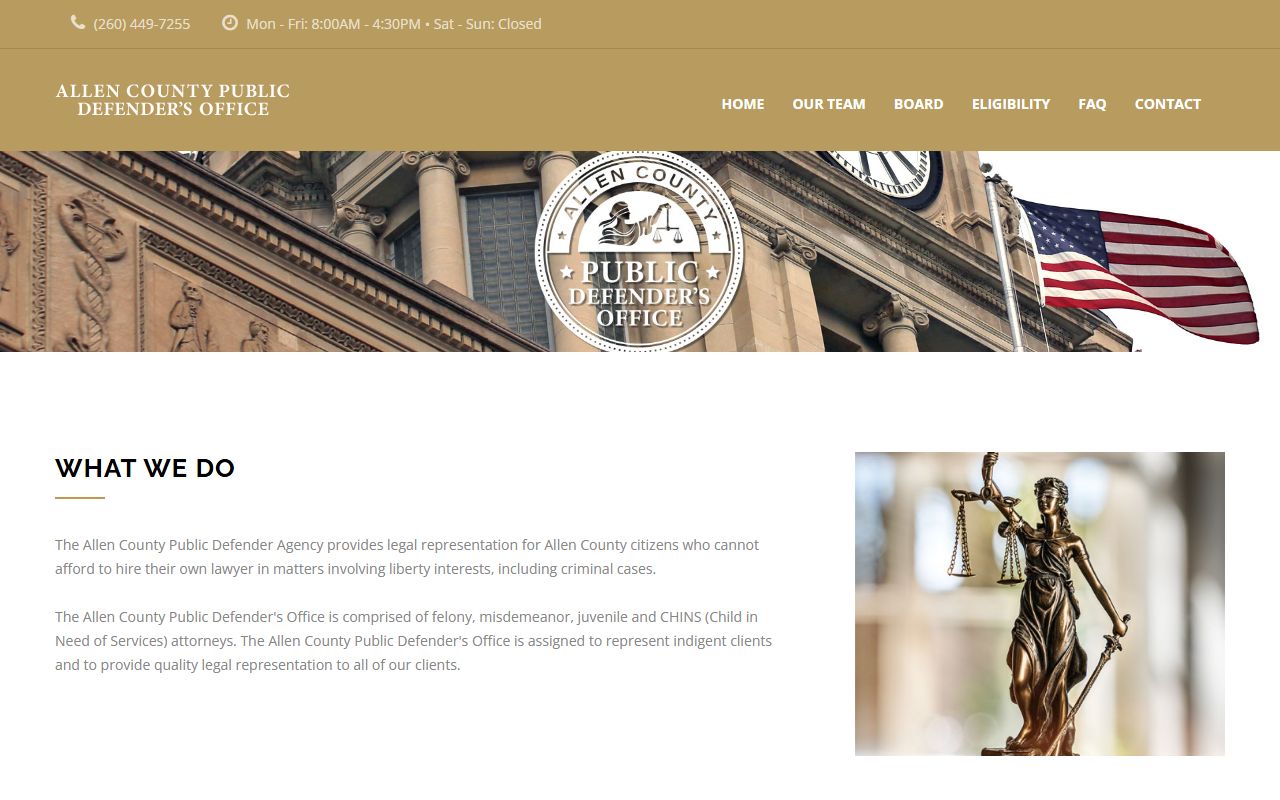
People charged with crimes who cannot afford a lawyer have a right to one. The Allen County Public Defender's Office represents indigent defendants in criminal, juvenile, CHINS, appellate, and capital cases. A county Public Defender Board, created by ordinance in 2003, oversees the office. The board has three members serving unpaid three-year terms.
The image below shows the county Public Defender Board page.
This screenshot is from the Public Defender Board page.
The office itself sits at 1 E. Main Street in Fort Wayne. The next image shows the Public Defender Office site.
This image comes from the Allen County Public Defender Office.
Eligibility runs through the courts. A judge appoints the public defender when a defendant qualifies in a liberty-interest matter.
Sheriff Criminal Records Check
For a formal background check, the Sheriff's Bureau of Identification runs a criminal records check. It costs $15.00 per request. You need two forms of ID, one a state-issued photo ID. A release form should be signed by the subject, and a form not completed in the office must be notarized. The Sheriff does not run checks on anyone under 18.
Sheriff Bureau of Identification
715 S. Calhoun Street, Room 101
Fort Wayne, IN 46802
260-449-3000
Note: a Sheriff records check covers local data, while a full statewide history comes through Indiana State Police channels.
Sealed vs Expunged Records in Allen County
Indiana lets people clear qualifying criminal records. Sealing limits public access to a record. Expungement, under IC 35-38-9, restricts a conviction or arrest record from public view. A granted expungement should drop off public MyCase, though a pending or denied petition may still show. Eligibility depends on the offense level and a waiting period, and each person generally gets one expungement opportunity.
| Sealed | Expunged |
|---|---|
| Record exists but is closed to the public | Record is restricted under IC 35-38-9 |
| Set by court order | Granted after a petition meeting eligibility |
| Still reachable by some agencies | May remain available to criminal justice agencies |
A petition usually must name the case, the law-enforcement agencies, the prosecutor, and the relief sought. Common denials come from an ineligible offense, an unmet waiting period, pending charges, or unpaid obligations.
Restricted and Juvenile Records
Some criminal-related records are closed. Juvenile court and law-enforcement records fall under IC 31-39 and are largely confidential, with access limited to parents, attorneys, agencies, and court-authorized people. Active investigation files, confidential informant data, and protected personal information can be withheld under Indiana's public-records law.
If you have an open matter, a warrant search may also be worth a look, and DUI or DWI cases overlap with traffic court records. For the full case file, return to Allen County court records.