
How to Apply for a Marriage License in Allen County
A couple needs a license to marry in Indiana. The Clerk's Central Services Division in Room 201 of the courthouse handles applications, Monday through Friday from 8:00 a.m. to 4:00 p.m. Plan for at least 30 minutes. You can start online with a state pre-application to save time, but both applicants must still appear in person to finish and pick up the license.
Here is the path most couples follow.
- Start the optional online pre-application through the state marriage system.
- Gather your IDs and proof documents before you go.
- Both applicants visit Room 201 together during application hours.
- Complete the application and pay the license fee.
- Receive the license, valid for 60 days, and arrange your ceremony.
The image below shows the official Allen County marriage-license page.
This screenshot is from the Allen County marriage-license page.
One reminder matters: cell phones, cameras, and other electronic devices are banned in the courthouse, so leave them behind.
Allen County Marriage License Fees
The fee depends on residency. Indiana residents pay one rate, and out-of-state couples pay more, since their ceremony must take place in the county. Certified copies carry a small separate fee. The table below lists the current amounts the Clerk publishes.
| Item | Fee |
|---|---|
| Indiana resident marriage license | $25.00 |
| Out-of-state resident marriage license | $65.00 |
| Certified copy | $4.00 |
The image below shows the Clerk's fee and cost page.
This screenshot is from the Allen County Clerk fee and cost information page.
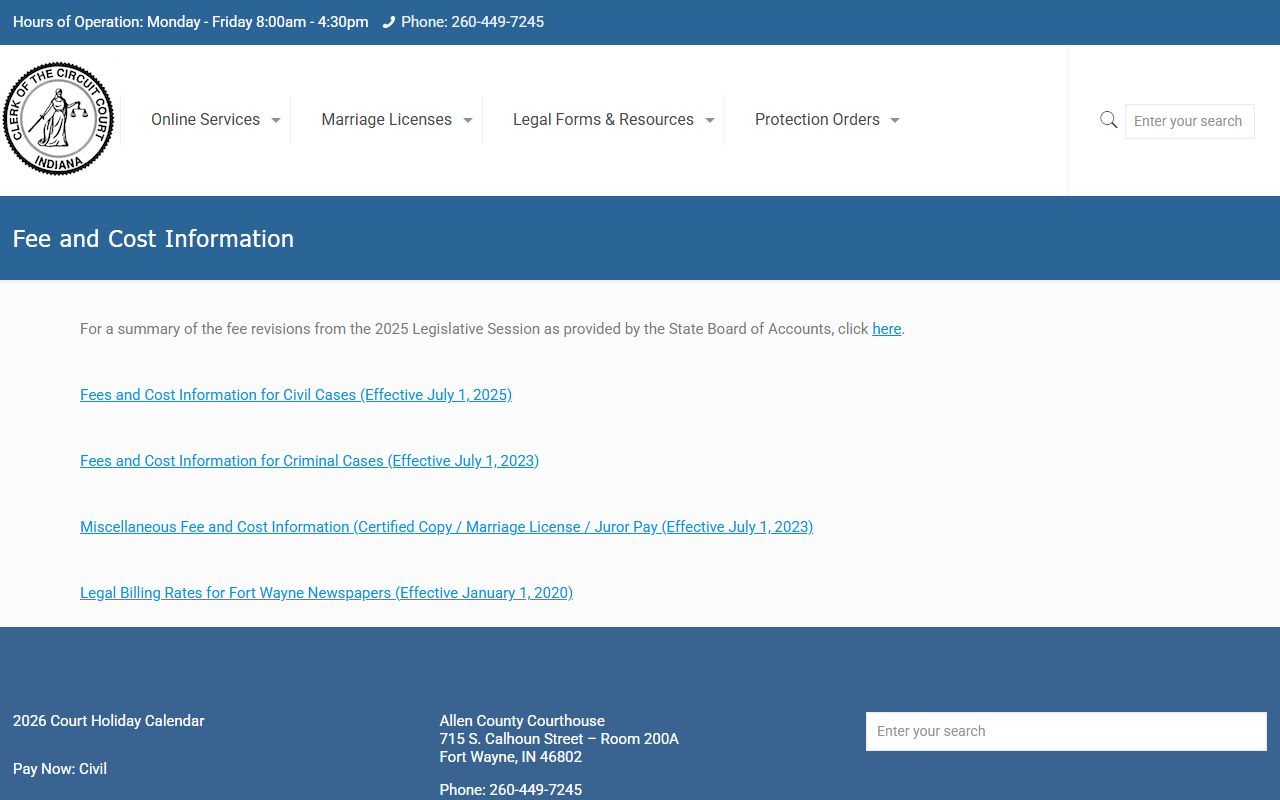
Pay by the method the Clerk accepts, and ask about copies of older, pre-1980 marriage licenses, since those amounts can vary.
Required Documents and Application Fields
Bring proof of identity and age. The Clerk's marriage information lists the documents an applicant can use, and an ID that does not show a current Allen County address means bringing separate proof of address. The table below shows what the application expects.
| Requirement | What Works |
|---|---|
| Photo ID with birth date | Valid driver's license or state ID. |
| Proof of birth date | Certified birth certificate, passport, or military ID. |
| Alternate birth proof | Baptismal certificate or school transcript with birth date. |
| Proof of address | Needed if the ID does not show an Allen County address. |
| Residency | At least one Indiana applicant must live in Allen County. |
Applicants under 18 need special consent, so call the Clerk first for those requirements.
Residency Rules and 60-Day Validity
Where you live decides where you apply. For Indiana residents, at least one applicant must live in Allen County to apply here, and Indiana residents from another county cannot apply in Allen County. Out-of-state couples may apply in Allen County only if the ceremony will take place in the county. The license is valid for 60 days after it is issued, and only for a marriage performed in Indiana.
Note: a marriage license is not the marriage itself, so the ceremony must happen within the 60-day window for the license to count.
Marriage License Lookup
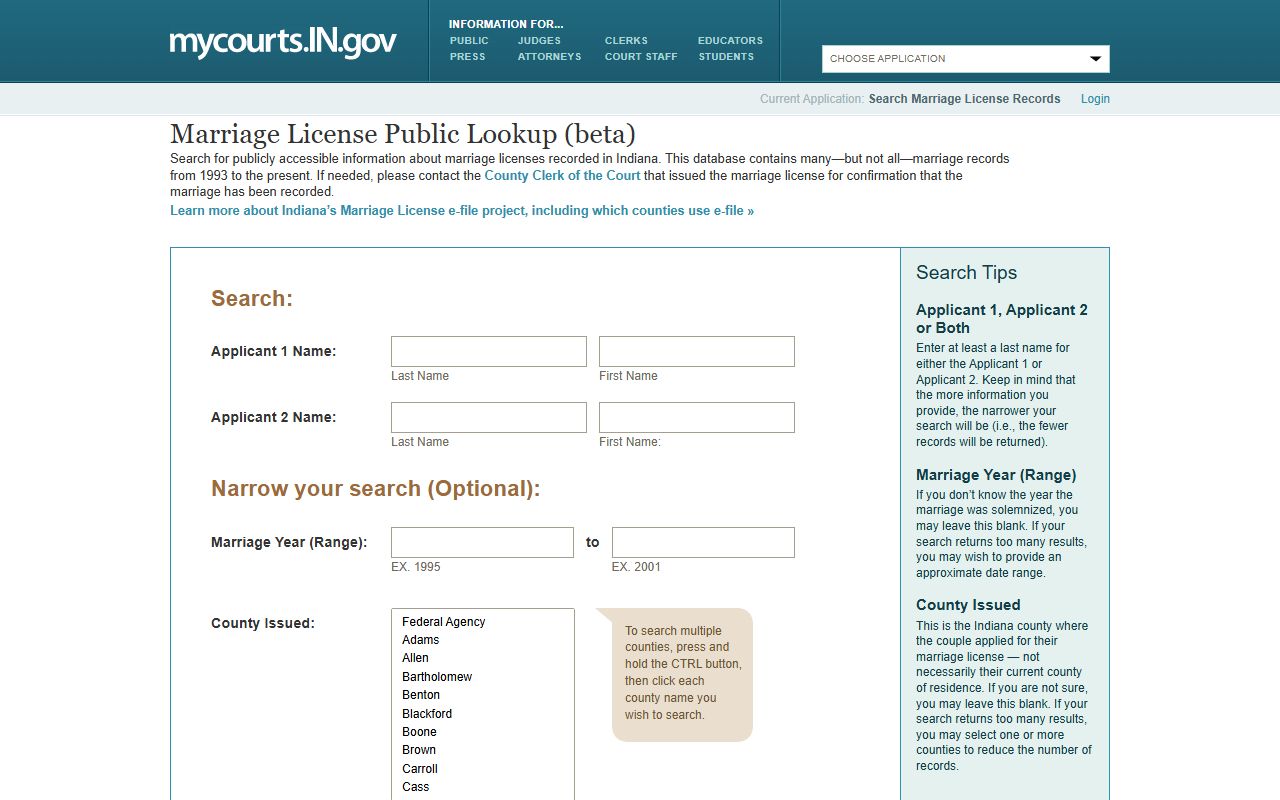
Indiana runs a public marriage-license search that the Allen County Clerk links to. You search by applicant name and can narrow by county. It is a free state portal, useful for confirming that a license was issued. The fields are below.
| Field | Type | Notes |
|---|---|---|
| Party name | Text | Search by an applicant's name. |
| County | Dropdown | Select Allen for local records. |
| Date / range | Date | Use if the date is known. |
You can run a license search on the state's marriage license public lookup. The portal is the quickest way to confirm a license without a trip to the courthouse, though a certified copy still comes from the Clerk.
Searching Allen County Divorce Records
Divorce records are court files, not Clerk-issued certificates. Dissolution cases run through the Allen Superior Court Family Relations Division and show up in MyCase. You search by party name, case number, or attorney, then narrow the court to Allen County. The docket shows filings, hearings, and the final decree once entered.
Privacy applies. Divorce filings can hold confidential information about children, finances, or protected addresses, and some documents are not posted online. For a certified divorce decree or a document that is not online, request it from the Clerk's Central Services Division. The Allen County court records page covers the MyCase search in detail.
Filing a new divorce follows a set order. Indiana publishes self-service family-law forms, and Allen County keeps its own family-court forms.
- Review the Indiana self-service forms and the Allen County family-court forms.
- File in the proper Allen County family-relations court if you meet residency and jurisdiction rules.
- Pay the filing fee, or ask for a fee waiver if you qualify.
- Serve the other party as the rules require.
- Track hearings and orders on MyCase, but get the certified decree from the Clerk.
Self-help options are linked through the Clerk's legal-forms resources, including the Indiana Coalition for Court Access.
Certified Copies and Officiants
Certified copies are the legal version. A certified marriage-license copy costs $4.00 from the Clerk, and certified court documents follow the standard copy and certification fees. As for who can marry you, Indiana law lets clergy, a judge, a magistrate, the clerk of the circuit court, and a city or town clerk officiate under IC 31-11-6.
For a judicial-officer ceremony, the marriage page lists the Circuit Court at 260-449-7602. To order a certified copy by mail or in person, see the steps on the Clerk of Court page. Probate and estate matters, which often follow a death in the family, are covered on the probate records page.
The Allen County Family Relations Division
Divorce is one part of a larger family docket. The Allen Superior Court Family Relations Division handles dissolution, custody, support, parenting time, and protective orders, with several judges and magistrates. Some of this work is based at the courthouse on Calhoun Street, and family-relations magistrates also use an office on North Wells Street.
Protective-order cases are a special case. They do not appear in MyCase, because federal law keeps the protected person's identifying details off online public access. Indiana runs a separate protection-order search for the public information that is released. For non-court public records the county keeps, such as deeds and business filings, see the public records page.