
How to Search Allen County Probate Records
Probate cases are searched the same way as other court files, through Indiana MyCase at public.courts.in.gov/mycase. You search by case number, party name, or attorney, then set the court to Allen County. A probate case opens with the decedent or protected person, the petitioner, and the chronological case summary of every filing and order.
Older or non-automated probate records may not be online. For those, the Clerk's Records Management Division in Room 202 and the copy process in Room 201 are the local path. Clerk records reach back to 1824, though retrieval time grows with the age of the file.
For the full MyCase walkthrough and search fields, see the Allen County court records page. Genealogy researchers also use probate files, since estate and guardianship cases name family members and tie into the county's long records history.
The Probate Division and Magistrate
Indiana does not run a separate probate court like a surrogate's court. Instead, the Allen Superior Court Civil Division handles probate, with a probate magistrate assigned to the docket. The Indiana court directory lists Probate Magistrate Phillip Houk at the courthouse. Use the contact below for probate questions.
Allen Superior Court, Probate
Probate Magistrate Phillip Houk
715 S. Calhoun Street
Fort Wayne, IN 46802
260-449-7543
The Clerk processes and files probate cases alongside civil, criminal, family, and small claims matters.
Allen County Probate Forms
The Clerk publishes a full set of probate forms approved for filing in Allen Superior Court. They cover the common steps of opening and closing an estate, plus guardianships. The list runs long, but a few forms come up most often.
- Petition for Probate of Will, in e-filed and not-e-filed versions.
- Petition for Appointment of Personal Representative.
- Personal Representative Letters and Oath.
- Inventory and Notice of Administration for Publication.
- Guardianship Information Sheet and Letters of Guardianship.
- Final Decree and Notice of Final Report in Estate.
The image below shows the Clerk's probate forms page.
This screenshot is from the Allen County probate forms page.
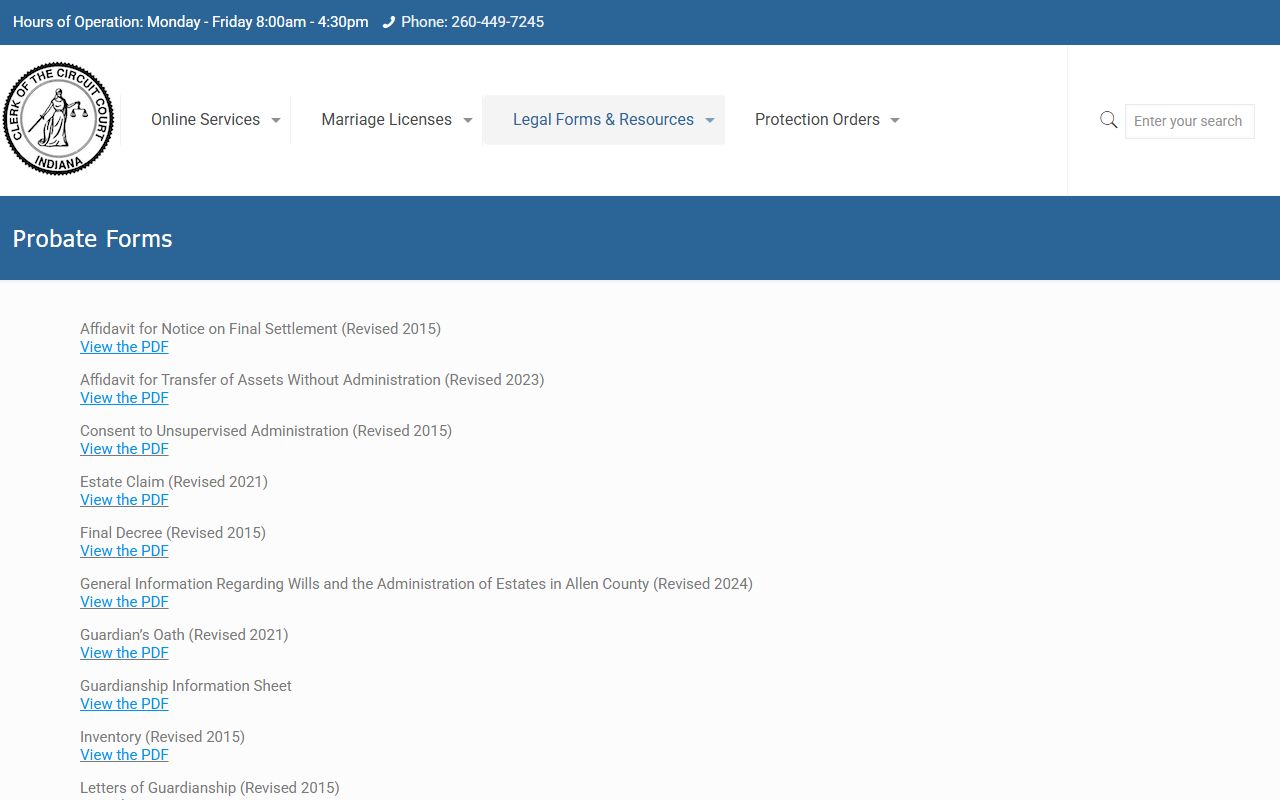
The same page also lists estate-claim, trust, and final-settlement forms for later stages of a case.
Probate Terms Defined
Probate uses words that rarely come up elsewhere. Knowing a few makes a case file far easier to read.
- Testator
- The person who made the will.
- Executor
- The person named to carry out a will, called a personal representative in Indiana.
- Intestate
- Dying without a valid will, so state law decides who inherits.
- Guardianship
- A court arrangement to care for a minor or an incapacitated person.
- Conservatorship
- Court-appointed management of another person's money or property.
These terms show up across the forms and in the docket entries for an estate.
What an Allen County Probate Record Shows
A probate file tracks an estate from opening to close. The docket and documents show who is involved, what was filed, and how the estate was handled. Expect these fields on a typical case.
- Case number and probate case type.
- Decedent or the protected person in a guardianship.
- Petitioner, personal representative, or guardian, plus the attorney.
- Filing date and whether a will was admitted or an estate opened.
- Claims filed, notices mailed or published, and the inventory.
- Letters issued, the final report or settlement, and court orders.
Financial and accounting documents can be restricted or redacted. Not every paper is online, so the Clerk holds the certified versions.
Estates, Wills, and Guardianships
Probate covers more than a single kind of case. A will is admitted and an estate is opened to pay debts and distribute property. A guardianship protects a minor or an adult who cannot manage their own affairs. Some small estates can skip full administration through an affidavit for transfer of assets, which the Clerk lists among its forms.
Administration can be supervised or unsupervised. Supervised administration keeps the court closely involved, while unsupervised administration gives the personal representative more room to act with fewer court steps. The notices forms differ for each, and the file shows which path an estate took.
How Probate Works in Allen County
An estate moves through clear stages. The exact path depends on whether there is a will and whether the estate needs supervised or unsupervised administration. The steps below outline the usual flow.
- Determine whether a will exists and whether estate administration is needed.
- Use the Allen County probate forms or hire counsel.
- File in Allen Superior Court by e-filing or the Clerk's procedures.
- Give notice to heirs, distributees, and creditors.
- Obtain letters of administration, guardianship, or personal representative letters.
- File the inventory and any accounting, and handle claims.
- Seek final settlement or a final decree to close the estate.
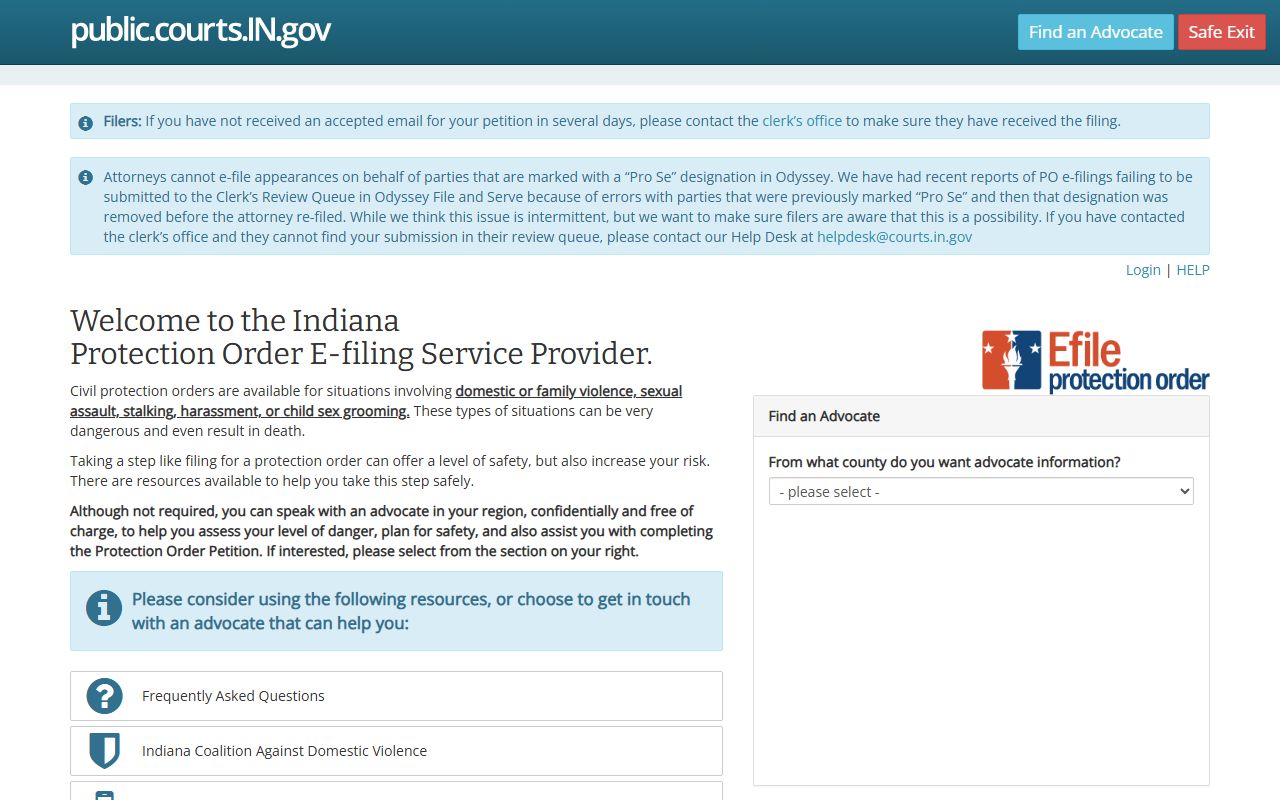
The Clerk links to a protection-order and e-filing system for electronic submissions. The image below shows that e-filing portal.
This screenshot is from the Indiana e-filing portal the Clerk links.
Probate Fees and Copies
Copy fees for probate records match the Clerk's standard rates. A plain copy is $1.00 per page, and certification adds $3.00 per document on top of the page fee. Certified copies are the version courts, banks, and agencies accept. Pay by check or money order made out to Clerk of Allen Circuit Court.
| Item | Amount |
|---|---|
| Plain copy, per page | $1.00 |
| Certification, per document | $3.00 plus the page fee |
Probate filing fees vary by case type and are set by Indiana statute, so confirm the current filing fee with the Clerk before you file. A small estate handled by affidavit usually costs less than a full supervised administration, since it skips many of the court steps. When in doubt, the Clerk can tell you which path your case needs and what it will cost to open.
Probate Help and Records Since 1824
Probate can turn on a dispute among heirs. The county links to a local mediators search for cases that may settle without a full hearing. Mediation is often faster and cheaper than a contested trial. The image below shows that mediator search resource.
This screenshot is from the Indiana court applications mediator search.
For the oldest estate files, the Clerk's records go back to 1824, with general indexes held in Room 202. To order a certified probate copy, the Clerk of Court page lists every request method, and the marriage and divorce records page covers related family filings.