
How to Search Allen County Warrants
The Sheriff's Warrant and Fugitive Division is the official source. It securely keeps the county's active warrants and answers questions by phone. The Sheriff also points the public to a recommended warrant network where you can look up wanted persons by Indiana county. Because that network is run by an outside group, treat the Sheriff's own warrant page as the official reference and the network as a starting point.
Before you act on any result, confirm it. A name match online is not proof, and warrant data changes as courts issue and recall orders.
- Read the official Sheriff Warrant and Fugitive Division page for current contacts.
- Use the Sheriff-recommended warrant lookup to browse by Indiana county and name.
- Call the Warrant Division to confirm an active warrant before you rely on it.
- If the warrant is yours, plan a surrender with photo identification.
- Speak with a lawyer about bond, recall, or quashing the warrant.
Do not approach or try to detain anyone who is listed. Contact law enforcement instead.
Types of Warrants the Sheriff Maintains
The Warrant and Fugitive Division handles more than one kind of order. Each comes from a different court process, but all authorize taking a person into custody. The division keeps the following types.
- Adult criminal bench warrants, often issued for a missed hearing or a court-order violation.
- Adult probation warrants for alleged probation violations.
- Parole warrants tied to post-release supervision.
- Family court warrants from family-relations matters.
- Small claims body attachments, a civil order to bring a person before the court.
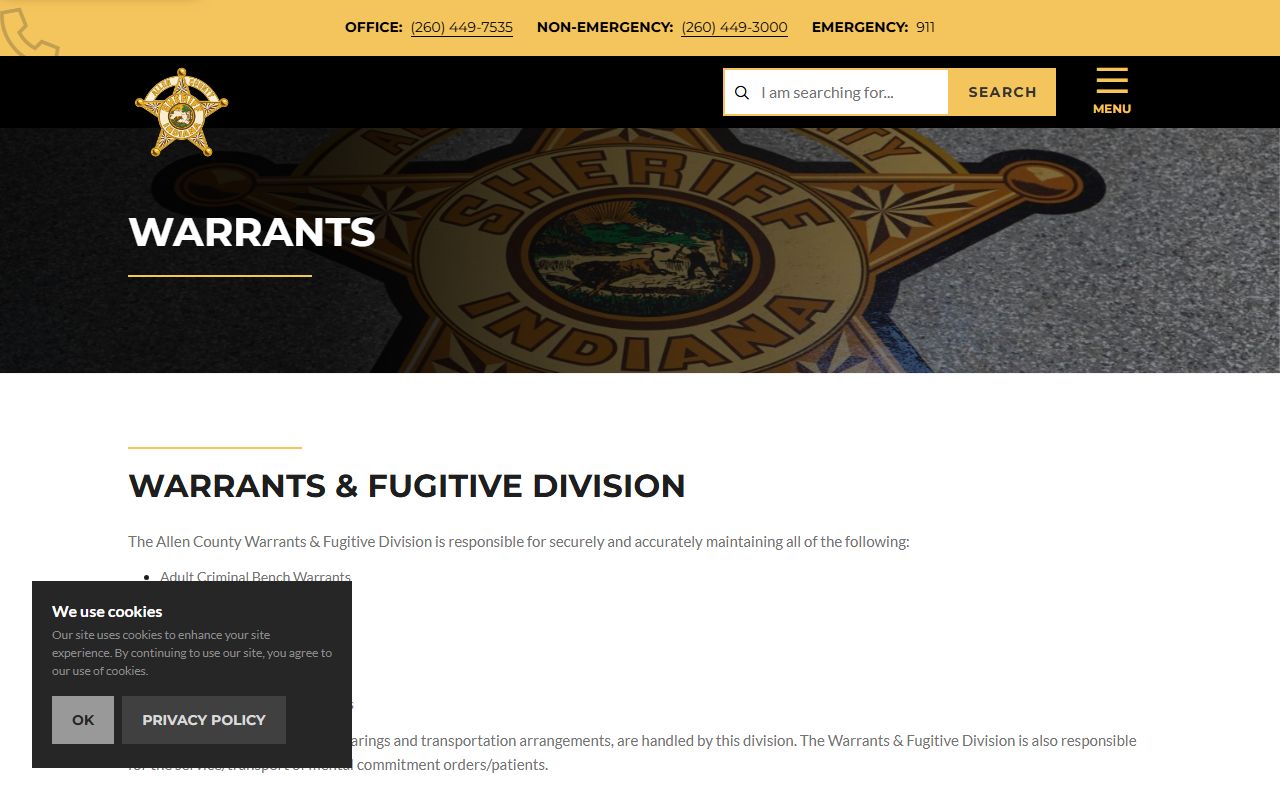
The image below shows the Sheriff's Warrant and Fugitive Division page.
This screenshot is from the official Sheriff warrants page.
A bench warrant is the type most people run into, since it often follows a skipped court date.
Allen County Warrant Lookup Fields
The Sheriff-recommended warrant network uses simple controls. You pick an Indiana county, then browse or search by name. The network also shows new warrants and a running count of active listings with an update date. The fields below describe how that lookup works.
| Control | Type | Notes |
|---|---|---|
| County | Dropdown | Select Allen County to focus the list. |
| Browse by letter | A to Z | Jump to last names by first letter. |
| Show new warrants | Filter | Surfaces recently added listings. |
| Active warrant count | Display | Total listings with an update date. |
This network is not hosted by the county, so always verify a hit with the Warrant Division before acting on it.
What an Allen County Warrant Record Shows
A public warrant listing is short. It is meant to identify a wanted person, not to publish a full case file. Expect these fields on a typical listing.
- Name of the wanted person.
- County tied to the warrant.
- Active status within the listing.
- An update date for the data.
- Warrant type, where the source provides it.
Bond type, bond amount, and a cause number usually do not appear on the warrant listing itself. Those show up later, on the jail roster after a booking or on the court record for the case.
The terms on warrant and court paperwork can be confusing. A few common ones are worth knowing before you call the Warrant Division.
- Bench warrant
- An order a judge issues, often after a missed hearing or a violated court order.
- Body attachment
- A civil order to bring a person before the court, used in small claims and family cases.
- Capias
- A warrant-like order directing officers to take a person into custody.
- Surety bond
- A bond posted through a bonding company that guarantees a court appearance.
How to Turn Yourself In
If the warrant is yours, the Sheriff lays out a clear path. You may surrender at the Allen County Lockup, Door #21, on the north side of Superior Street between Calhoun and Clinton. Bring a photo ID. The Sheriff warns that the warrant is already in a statewide computer system, so any law-enforcement contact can lead to an arrest. Handling it on your terms is usually better than waiting.
Warrant and Fugitive Division
Allen County Courthouse, Room 104
715 S. Calhoun Street
Fort Wayne, IN 46802
260-449-7636
Mon-Fri 8:00 a.m. to 4:30 p.m.
A lawyer or the public defender, if you qualify, can advise on bond and a possible recall.
Bail by Cash or Surety
Release usually means posting bail. The Sheriff says bail may be posted by cash or by surety bond. A cash bond is paid in full. A surety bond runs through a bonding company that guarantees your court appearance for a fee. The court sets the amount and any conditions.
The amount is not random. A judge sets bail based on the charge, the person's record, and the risk of missing court. On some bookings the Sheriff lists pretrial services instead of a dollar bond, which means supervised release rather than cash. If you cannot afford the amount, a lawyer can ask the court to lower it or to change the conditions.
Note: a body attachment or a family court warrant may carry its own release terms, so confirm the exact amount and method with the court that issued it.
Tip Lines for Allen County Warrants
The Sheriff runs confidential ways to report a wanted person. Do not try to make an arrest yourself. Use one of these lines instead.
Warrants Tip Hotline
Allen County Sheriff
260-449-3343
Crime Stoppers
Fort Wayne / Allen County
260-436-STOP (7867)
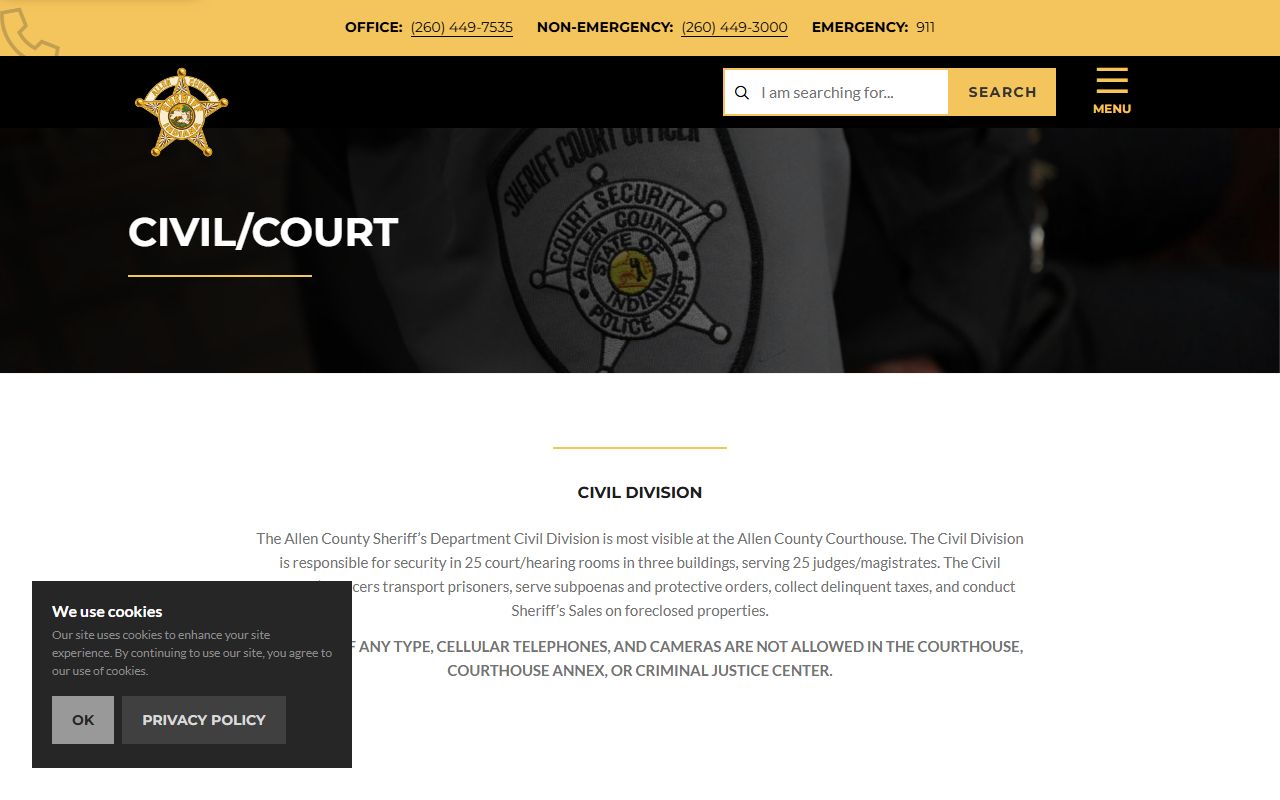
The image below shows the Sheriff's Civil and Court Division, which supports courthouse security and service.
This screenshot is from the Sheriff Civil and Court Division page.
Warrants in Court Records and Jail Data
A warrant rarely sits alone. After a court issues one, it appears in the case on MyCase, often as a bench warrant entry on the docket. After a person is booked, the related charge and cause number show on the Sheriff's inmate detail page. So a warrant search and a court search work together.
The image below shows a Sheriff warrant page detail.
This image comes from the Sheriff warrants page.

To follow the case behind a warrant, search the Allen County court dockets by name.
Extraditions and Mental Commitment Orders
The Warrant and Fugitive Division does more than local warrants. It handles all extraditions, including the court hearings and the transport that move a wanted person between jurisdictions. It is also responsible for serving and transporting mental commitment orders and patients. These duties are court-driven and follow strict legal steps.
For custody questions tied to a warrant, the Allen County inmate records page covers booking and the jail roster.
Extradition can take time. When another state holds a person Allen County wants, or when Allen County holds someone wanted elsewhere, the division coordinates the legal steps and the transport. A person may sit in custody during that process. Family and friends often ask how long it takes, and the honest answer is that it varies with the courts and the other jurisdiction involved.